Sounds are off by default. Your choices stay on this device.
Loading page…
Mathematics & Physics · University of BathGraduating 2029
Hello, I’m
Preston Whiteman.
Exploring quantitative finance through mathematics and code.
I’m a first-year Mathematics and Physics student at Bath. I build models to understand how they work, how to test them, and where their answers stop being useful. Here you’ll find my option-pricing project, research internship and the people-facing work alongside them.
One is about measuring uncertainty in a model. The other is about helping colleagues work with evidence.
Independent project · PythonOngoing
Monte Carlo option pricing
How much should I trust a simulated option price?
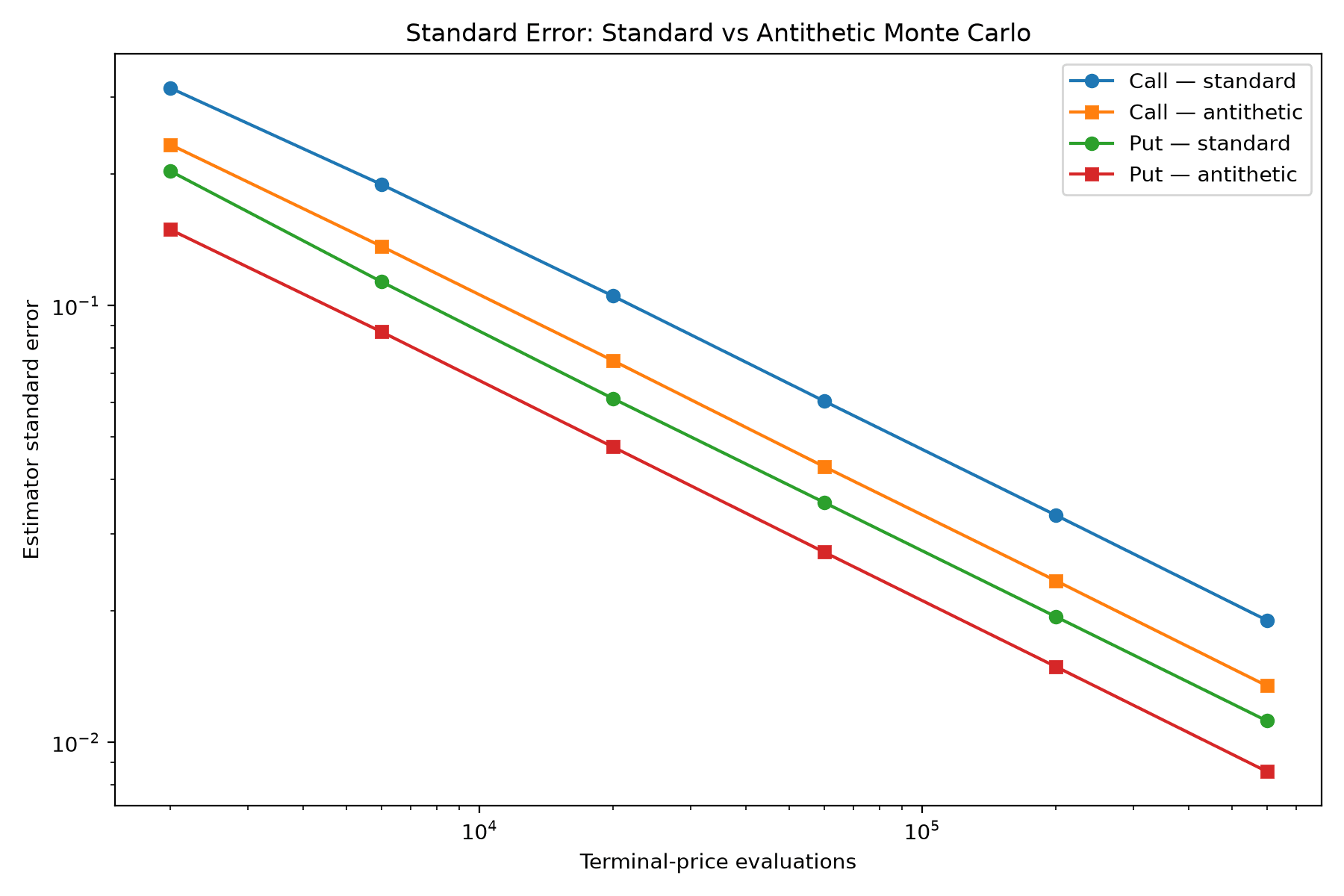
I built a Python engine for European calls and puts, checked it against Black–Scholes, then studied the uncertainty in both prices and Greeks. The key comparison: can antithetic sampling reduce noise with the same number of terminal-price evaluations?
600,000evaluations in the recorded benchmark
1.996×call variance-reduction factor
59automated tests in the repository
Constant-volatility GBM; a numerical-methods study. These results do not establish performance against market data.
Antithetic sampling lowered the standard error in the recorded call and put experiments. The case study explains the equal-budget comparison and how the uncertainty is calculated.Examine the recorded results ↗
Bath Insights internship · June–July 2026
Making research-impact evidence easier to review.
I worked with another intern on evidence for approximately four REF2029 case studies. I developed a Python workflow with a locally hosted language model, structured Excel exports and an internal interface, then refined it with feedback from colleagues.
The scale
50+ research outputs; 200+ evidence items reviewed a day during the internship.
My focus
Classification, reviewable outputs, the interface and documentation for handover.
Observed variance-reduction factor: 1.97×. Antithetic uncertainty is calculated across independent pair averages, not individual correlated payoffs.
Fixed seed, European payoff, constant-volatility GBM. Each estimator uses the same total number of terminal-price evaluations. More samples reduce typical uncertainty; a single realised error need not improve monotonically. The Python project contains the full validation.
The degree brings my interests in theoretical physics and quantitative finance closer together.
After first-year study in Physics, I moved to Mathematics and Physics. I wanted to spend more time on the mathematical ideas behind the physical models, while exploring how the same tools are used in finance.
The Monte Carlo project gives me something concrete to question beyond a problem sheet. I also recently completed the initial round of the International Youth Math Challenge, receiving a commendation for my submission.
Alongside the course, I’m an AI team programmer and EDI Lead in Team Bath Racing Electric, and the elected Mathematics and Physics Academic Representative and a SUmmit member for 2026/27.
Speedy 6, Meet UBS LondonI led our team to first place among 40 teams in the graduate challenge.A seat at the tableThe Vice-Chancellor’s Breakfast: student voice, access and opportunity.21.1 km. One cow costume.Running the Bath Half for Student Minds and raising over £200.
04 / Get in touch
Have something I could learn from or contribute to?
I’m interested in insight programmes, internships and technical projects in quantitative finance, research or software. I’d be glad to talk about the work here.